
How Long Does a Home Inspection Take?
How long a home inspection really takes, what makes one run long, and why the number that matters more is how long the inspector spends explaining it.
AZ Home Inspection ServicesSeptember 4, 20265 min read
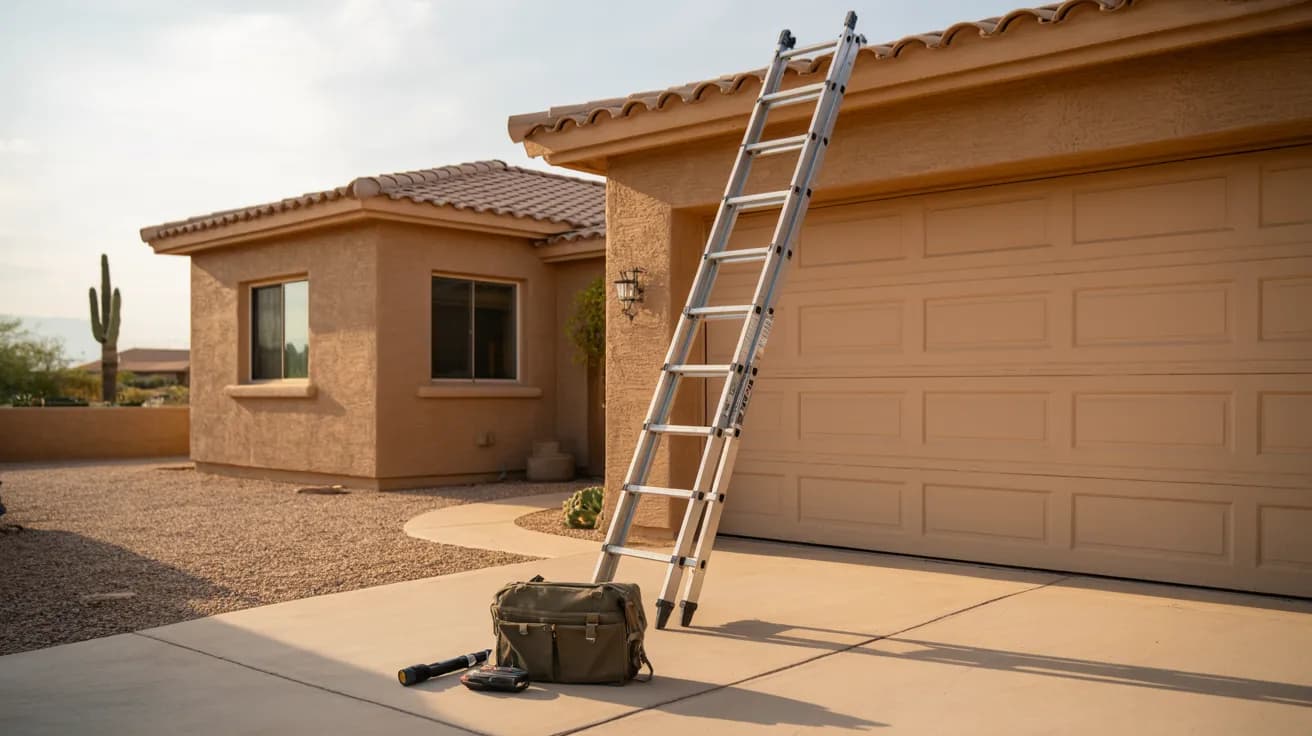
It is the first question almost everyone asks when they book, and the honest answer is a range rather than a number: most residential home inspections take a few hours on site. Where a specific house lands in that range depends on four things — how big it is, how old it is, how many systems it has, and how much of it the inspector can actually reach.
Here is what actually fills those hours, and what to do with them.
What the time is actually spent on
An inspection is not one long walk. It is a sequence of separate examinations that happen to occur in the same building, and each one has its own pace.
The roof and the exterior usually come first, because they are weather- and light-dependent. On an Arizona tile roof, this is rarely a quick glance: barrel tile hides its problems underneath, so the details that matter are the flashings, the penetrations, the valleys and the underlayment condition where it can be seen. A simple shingle roof on a small single-storey can be covered quickly. A multi-plane tile roof on a custom home cannot.
The structure, grading and drainage come next — foundations, walkways, and how the lot moves water away from the house. In the Valley this is one of the most consequential sections of the whole report and one of the least appreciated, because the consequences of getting it wrong only appear during monsoon season.
Then the interior systems: electrical, plumbing, heating and cooling, and the built-in appliances. This is the slowest part, and it is slow for a good reason. Every outlet that should be GFCI-protected gets checked. Every fixture gets run. The panel comes off. Water heaters, vents and flues get looked at properly rather than noted in passing.
Finally, and this is the part people underestimate, there is the walkthrough: the conversation at the end where the inspector explains what was found, separates the urgent from the merely worth-watching, and answers your questions.
The four things that actually move the clock
Square footage. The most obvious one. More house means more rooms, more outlets, more fixtures, more roof.
Age. An older home carries more history. Original panels, cloth-era wiring, plumbing that has been partly updated, additions and remodels of unknown provenance — each of these is something to work out rather than something to tick off. A well-documented new build moves faster than a much smaller home that has been through four owners and three remodels.
Number of systems. Two HVAC units take longer than one. A pool and spa is an entire separate certified inspection. A casita, a workshop, or a detached garage is more building to cover.
Access. This is the one nobody plans for, and it is worth planning for. An inspector cannot report on what cannot be reached. A panel blocked by storage, an attic hatch buried under boxes, a crawlspace with a stuck door, a water heater walled in behind shelving — every one of those either adds time or produces a "not accessible" note in your report, which helps nobody.
What you can do to make it go faster
Sellers can genuinely shorten an inspection, and it costs nothing:
- Clear access to the electrical panel, the water heater, the attic hatch and the furnace or air handler.
- Make sure the utilities are on. An inspector cannot test a system with no power, no gas and no water — and a "could not be tested" line is the least useful thing in any report.
- Leave keys or codes for the pool equipment, the gate, the shed and anything else that locks.
- Take the pets somewhere else for the morning. This is for their sake as much as anyone's.
Buyers do not need to do anything except show up for the end.
The number that actually matters
There is a version of this question that is more useful than "how long": how long does the inspector spend with you afterwards?
An inspection that takes three hours and ends with a PDF emailed the next day has given you a document. An inspection that takes the same three hours and ends with someone walking you through what they found, in the house, pointing at the actual thing — that has given you an understanding. Those are not the same purchase, even at the same price.
At AZ Home Inspection Services the report is finished on-site and delivered before the inspector leaves, and you are welcome to follow along for the whole inspection and learn as much as you want to. The findings get explained to you and your agent together, with the major items separated from the deferred-maintenance items, and every finding carries a photograph so you can hand it to a contractor for a quote.
If you would rather go through it again later, there is a Zoom review available, and the report itself is built to be re-read — you can filter it down to just the safety hazards, or jump to any section.
Be suspicious of a very short inspection
There is no universal minimum, and a genuinely small, genuinely new home can be inspected properly in less time than a big one. But if an inspection on a normal family home is over remarkably quickly, it is worth asking what was covered.
The reference point is the ASHI Standards of Practice, which set out what a home inspection is supposed to include: structural systems, roofing, electrical, plumbing, heating and cooling, and built-in appliances. An inspection that follows those standards takes the time it takes. One that finishes early has usually skipped something — and the thing it skipped is the thing you will find out about later, at your own expense.
Planning your day
A practical rule for scheduling: block out half a day. Not because the inspection needs it, but because you want to arrive without rushing, be there for the walkthrough without watching the clock, and have time afterwards to think about what you heard before your agent needs an answer.
The inspection is one of the few points in a home purchase where slowing down is free and rushing is expensive.
Ready to book? Get a quote with the size, approximate age and location of the property, or call 480-805-2025.
Need an inspection in the Valley?
Bob Clardy has performed more than 10,000 inspections across the Phoenix metro. Residential inspections start at $285, report delivered on-site.
Frequently asked
How long does a home inspection take?
Most residential inspections take a few hours on site. The length scales with the size, age and complexity of the property — a small production home moves quickly, while a large custom home with multiple HVAC systems, a pool and long tile roof runs takes considerably longer.
Do I need to be there for the whole thing?
No. The part worth being there for is the walkthrough at the end, where the inspector goes through the findings with you and your agent. That said, you are welcome to follow along for all of it and ask questions as they come up.
When do I get the report?
With AZ Home Inspection Services, before the inspector leaves. Reports are finished on-site and delivered as a visual HTML and PDF document with photographs against every finding.
Does a bigger house always take longer?
Usually, but square footage is not the only driver. A 1,900 sq ft home from 1962 that has been remodelled three times can take longer than a 3,000 sq ft home built last year, because there is more history to untangle.
- home inspection
- buying a home
- what to expect